
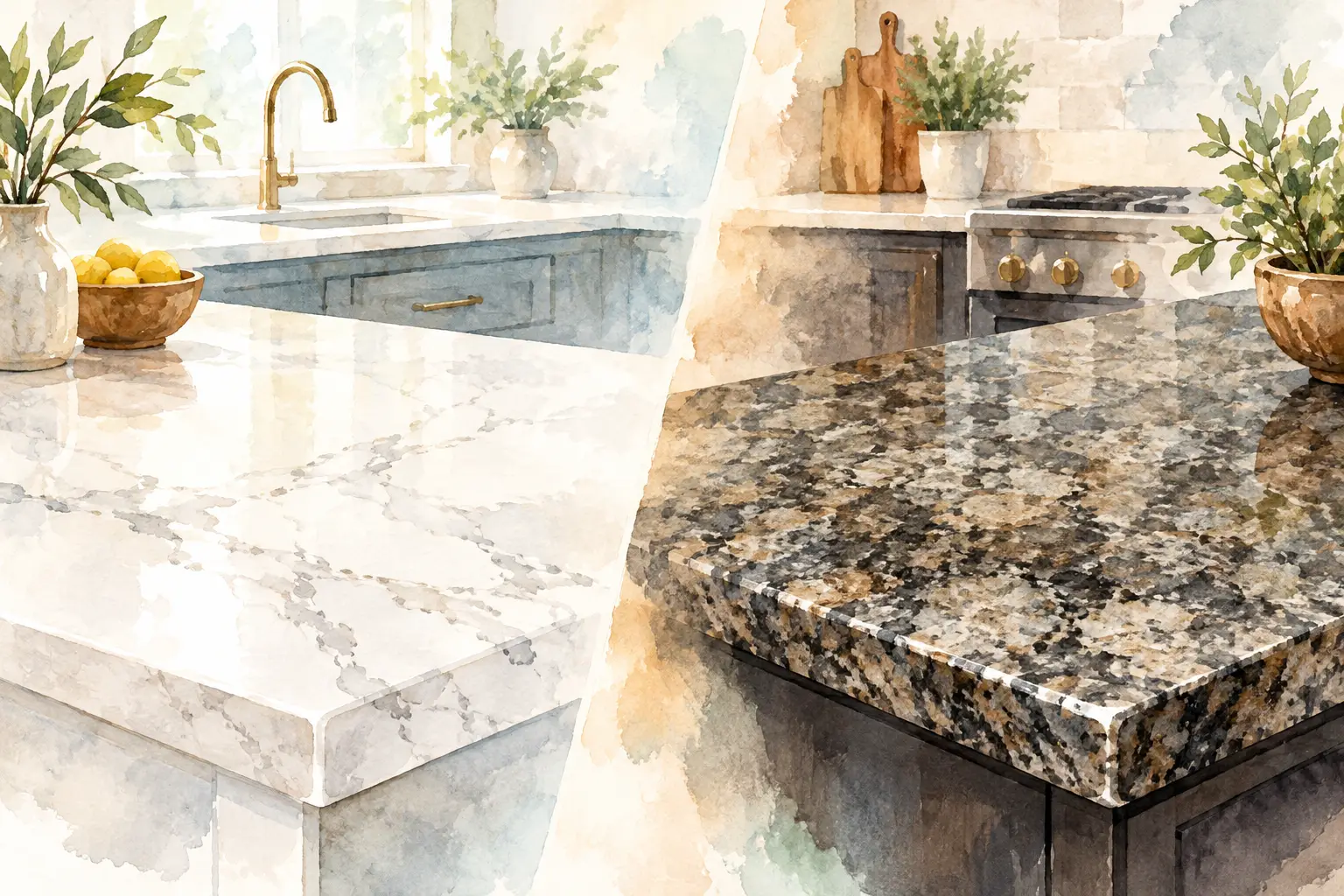
A countertop choice gets tested long after the showroom visit. It meets hot pans during weeknight dinners, school projects, spilled coffee, holiday cooking, and the everyday habit of dropping keys on the island. When homeowners compare quartz versus granite countertops, the better option is rarely the one with the most impressive sample. It is the one that suits how the kitchen will actually be used.
Both materials can create a beautiful, lasting kitchen. Granite brings the character of natural stone, while quartz offers consistency and lower-maintenance performance. The right choice comes down to your priorities for appearance, care, budget, and the rest of the remodeling plan.
Granite is a natural stone cut from the earth into slabs. Each slab has its own mineral patterns, color movement, veining, and small variations. Even samples from the same granite selection can look noticeably different, which is part of the appeal for homeowners who want a kitchen with one-of-a-kind character.
Quartz countertops are engineered surfaces. They are made primarily from ground natural quartz combined with resins and pigments, then formed into slabs. That manufacturing process gives quartz a more controlled appearance. Homeowners can choose from soft whites, concrete-inspired finishes, bold colors, or patterns designed to resemble marble and natural stone.
Neither is automatically more upscale. A well-selected quartz countertop can look refined and tailored, while a high-quality granite slab can be the visual centerpiece of the room. The key is choosing a material that works with the cabinetry, flooring, backsplash, lighting, and the level of visual movement you want in the space.
Granite works especially well when a homeowner wants visible depth and natural variation. Its movement can bring warmth to painted cabinets, complement wood tones, and make a large island feel distinctive. Because granite is naturally formed, it may include pits, fissures, or changes in color. These are normal characteristics, not necessarily defects.
That variation does require a thoughtful selection process. A small sample cannot show everything that will appear across a full slab. Whenever possible, it helps to view the actual slab before fabrication, especially for a kitchen with a large island or prominent countertop runs.
Quartz is often a strong fit for kitchens with a clean, coordinated look. Its pattern is more consistent from one area to another, making it easier to plan how the countertop will look around a perimeter, island, or waterfall edge. A marble-look quartz can deliver soft veining without the unpredictability of a natural slab.
Consistency is not the same as boring. Many modern quartz options have layered patterning and subtle movement. Still, if you love the idea that no one else will have exactly your countertop, granite has an advantage.
For many busy households, maintenance is where quartz pulls ahead. Its nonporous surface does not usually need sealing, and it resists common kitchen stains from coffee, cooking oil, juice, and wine. Most daily cleanup requires mild soap, water, and a soft cloth.
Granite is also durable, but it is porous to varying degrees. It should be sealed to help protect it from moisture and stains. How often depends on the specific stone and the sealer used, but homeowners should expect periodic maintenance as part of owning granite. Wiping spills promptly is a smart practice with either material, especially around seams and the sink.
Neither countertop should be treated as indestructible. Avoid harsh chemicals, abrasive scrubbers, and concentrated cleaners that can dull the finish or affect protective treatments. A contractor or fabricator can provide care instructions for the exact product selected, which is more useful than relying on a generic cleaning tip online.
Granite handles heat well. It is generally more forgiving if a warm serving dish or hot cookware briefly lands on the counter, although trivets are still the safer habit. The surface also resists scratching under normal kitchen use. Cutting directly on any countertop is not recommended, both to protect the surface and to preserve kitchen knives.
Quartz is highly scratch-resistant and performs well under normal daily use, but the resin content makes it more sensitive to high heat. A hot pan placed directly on quartz can cause discoloration, cracking, or thermal damage. If your kitchen sees frequent stovetop-to-counter transfers, make room for trivets near the range and island.
This does not make quartz impractical for cooks. It simply means the household needs a consistent habit. For homeowners who prefer the most heat-tolerant surface possible, granite may feel like the more comfortable choice.
Homeowners often ask which option costs less. The honest answer is that both quartz and granite have a wide price range. Entry-level granite may cost less than premium quartz, while an exotic granite slab may cost more than many quartz selections.
The final countertop investment also includes factors beyond the material itself: slab availability, thickness, edge profile, sink cutouts, backsplash height, seam placement, demolition, fabrication, and installation. A large island, full-height backsplash, or detailed layout can significantly affect the final number.
During a kitchen remodel, countertop pricing should be considered alongside the full project scope. A countertop that costs slightly more but supports the cabinet color, layout, and long-term maintenance preferences may be a better value than a lower-priced option that feels like a compromise every day. Clear planning helps prevent a surface selection from forcing unexpected changes elsewhere in the design.
Both materials can chip at an edge if struck hard enough, especially near a sink or dishwasher. Small chips can sometimes be repaired, but an invisible repair is not guaranteed. Granite repairs may blend differently depending on the stone’s pattern. Quartz repairs can also vary based on color and finish.
Seams are another practical consideration. Most kitchens need at least one seam because slabs come in fixed sizes. Quartz seams can sometimes be less noticeable because the pattern is controlled, but that depends on the color and installation. A granite seam may be more visible in a heavily patterned slab, yet careful layout planning can reduce the distraction.
The quality of fabrication and installation matters just as much as the material. Proper support, accurate templating, good seam placement, and careful handling around cutouts all affect how a countertop looks and performs over time.
Quartz is often the right fit for homeowners who want easy cleanup, a consistent color or veining pattern, and little ongoing maintenance. It is particularly practical for active family kitchens where spills happen and the countertop needs to look orderly with minimal effort.
It can also be a smart choice when a design calls for a very specific look. If you want bright white surfaces, a subtle marble-inspired pattern, or a uniform modern finish, quartz offers many reliable options. Just plan for heat protection near cooking areas and avoid using it in outdoor spaces where direct sunlight can affect some products.
Granite is a strong choice for homeowners who appreciate natural materials and want a countertop with real variation. It works beautifully in traditional, transitional, and warm contemporary kitchens, particularly when the design benefits from organic movement rather than a uniform surface.
It is also appealing for serious cooks who value strong heat resistance. If resealing occasionally does not bother you, granite offers durable performance and a distinct look that manufactured materials cannot fully duplicate.
Countertops should not be selected in isolation. Cabinet door style, hardware, flooring, lighting, backsplash, and the kitchen’s natural light all influence whether a slab feels balanced or overwhelming. A busy granite may be stunning against simple cabinetry but compete with a patterned backsplash. A quiet quartz may give a compact kitchen the open, calm feeling it needs.
At 3C Remodeling and Construction, we help homeowners consider these choices as part of a complete kitchen plan, not as a last-minute surface decision. The goal is a kitchen that supports meal prep, gathering, storage, cleaning, and the routines that fill a home.
If you are deciding between quartz and granite, bring a few real-life questions to the conversation: How often do you cook? Do you want a natural, one-of-a-kind slab? Are you comfortable with periodic sealing? Which cabinet and backsplash selections are already in place? Those answers will point you toward a countertop that still feels right after the first busy year in your new kitchen.
Business Name: 3C Remodeling and Construction
Address: 1902 Campus Pl Suite 12, Louisville, KY 40299
Phone: 502-827-1361
Business Hours:
Mon - Fri: 08:00 AM to 05:00 PM
Sat-Sun: Closed
Referral program available