
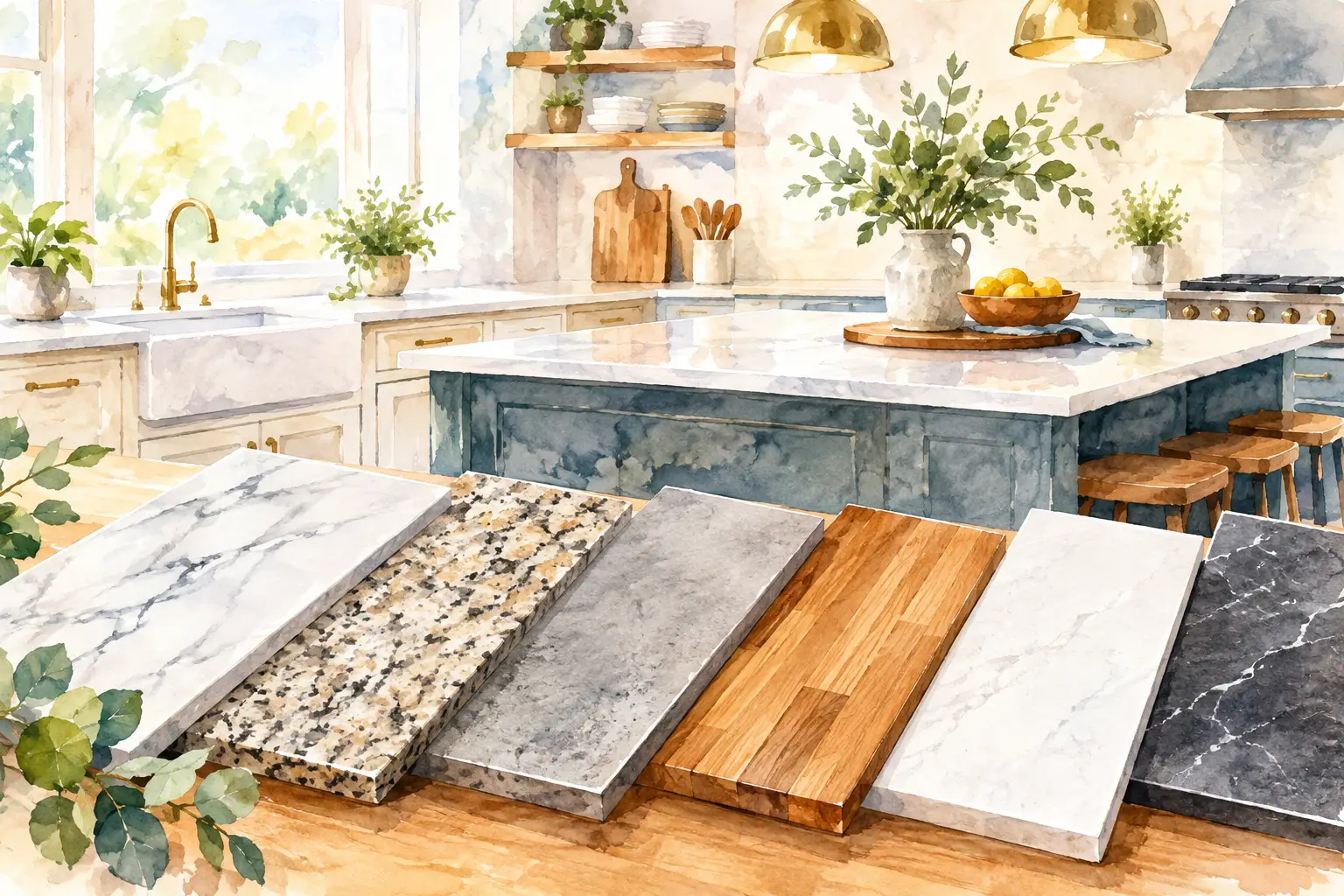
The countertop is where weekday breakfasts, school projects, holiday baking, and quick dinners all seem to land at once. That is why choosing among the best kitchen countertop materials is about more than picking a color or following a trend. The right surface needs to support the way your household cooks, cleans, gathers, and uses the kitchen every day.
A countertop can be beautiful in a showroom and still be frustrating at home if it stains easily, shows every fingerprint, or requires more upkeep than you want to give it. As you plan a kitchen remodel, consider durability, maintenance, budget, and how the countertop will work with your cabinets, backsplash, sink, and overall layout.
There is no single best choice for every Louisville-area home. A busy family that regularly cooks from scratch may prioritize a surface that resists stains and needs little maintenance. A homeowner creating a warm, traditional kitchen may be willing to care for natural stone or wood because the character matters more than perfect uniformity.
Start by being honest about how you use your kitchen. Do you set down hot pans without thinking? Do children do homework at the island? Is your kitchen the main gathering place when friends and family visit? Those answers will point you toward a material that feels good to live with, not just one that photographs well.
It also helps to look at full samples in your own space. Lighting can change a countertop dramatically. A slab that looks bright white under showroom lights may read much warmer or cooler beside your existing flooring and paint.
Quartz is one of the most popular countertop choices for homeowners who want the appearance of stone with easier daily care. It is an engineered material made from natural quartz combined with resins and pigments, which creates a nonporous surface available in a wide range of colors and patterns.
Because quartz does not typically require sealing, it is a practical option for busy kitchens. It resists stains from common spills such as coffee, oil, and juice, and its consistent pattern can make it easier to coordinate large islands, perimeter counters, and backsplashes.
The trade-off is heat sensitivity. Quartz can be damaged by very hot cookware, so trivets are still a good habit. It is also usually a higher-cost option than laminate or butcher block. For many families, though, the combination of durability and simple upkeep makes quartz a strong long-term investment.
Granite remains a favorite for homeowners who want genuine natural stone and a countertop that will not look exactly like anyone else’s. Every slab has its own veining, movement, and color variation, from subtle speckling to bold patterns that become a focal point in the kitchen.
Granite handles heat well and offers excellent durability when properly installed and maintained. It does need periodic sealing, depending on the specific stone and finish, to help prevent staining. Some homeowners enjoy that small amount of care; others would rather choose a material with fewer maintenance needs.
Granite is especially appealing when a kitchen design calls for warmth, depth, and natural variation. Visit the slab yard if possible rather than selecting from a small sample. The full slab is what will define the finished look of your kitchen.
Marble has an unmistakable look. Its soft veining and natural brightness can make a kitchen feel timeless, elegant, and welcoming. It works particularly well in traditional, transitional, and European-inspired designs.
However, marble is not the best fit for every household. It is softer and more porous than quartz or granite, meaning it can scratch, etch, or stain more easily. Acidic foods and drinks, including lemon juice, wine, and vinegar, can leave dull marks on polished marble.
That does not mean marble is off limits. It simply works best for homeowners who appreciate the natural patina that develops over time or who use it in a lower-impact area, such as a baking station, coffee bar, or island section. If you want a pristine surface with minimal worry, quartz or porcelain may be the better direction.
Wood countertops bring a warmth that stone and manufactured surfaces cannot quite duplicate. Butcher block can soften a kitchen with painted cabinets, create a welcoming island, or add contrast in an otherwise neutral design.
It is also comfortable for food preparation and can be refinished if it develops scratches or wear. That repairability is a meaningful advantage. Still, wood requires regular oiling or sealing, and it should not be treated like a place to leave standing water. Areas around sinks need particular attention.
Butcher block is often most successful when used strategically rather than throughout the entire kitchen. A wood-topped island paired with durable quartz or granite perimeter counters can give you warmth where you want it and easier cleanup where you need it most.
Modern laminate has come a long way from the surfaces many homeowners remember from decades ago. Today’s options can imitate stone, wood, concrete, and other high-end finishes at a much more accessible price point.
Laminate is easy to clean, available in many colors and patterns, and can be a practical choice for a kitchen refresh, rental property, secondary kitchen, or budget-conscious remodel. It is not as heat- or scratch-resistant as stone, quartz, or porcelain, and damaged edges or seams can be difficult to repair.
For homeowners considering cabinet refacing or a focused kitchen update, laminate can make sense when the goal is a clean, coordinated look without committing the budget required for premium stone. The key is choosing a quality product and thoughtful edge detail so the finished kitchen feels intentional.
Solid-surface countertops offer a clean, uniform appearance with inconspicuous seams and integrated sink options. They are nonporous, easy to maintain, and available in many neutral colors and subtle patterns.
This material is softer than quartz and natural stone, so it can scratch or scorch. The upside is that many minor scratches and marks can be professionally repaired. Solid surface is a good option for homeowners who value a smooth, practical countertop and prefer a quieter look over dramatic veining.
Porcelain slabs are becoming more common in kitchen remodeling because they offer impressive heat, stain, and scratch resistance. They can be manufactured to resemble marble, concrete, metal, or natural stone while requiring far less maintenance than some natural materials.
Porcelain is a strong contender for households that cook often and want a high-performance surface. It is also useful for creating a coordinated look across countertops, backsplashes, and even fireplace surrounds. Installation requires experienced fabrication and handling, since the slabs can be thin and must be cut carefully, but the finished result can be striking and durable.
The material is only part of the decision. Edge profiles, seams, overhangs, backsplash choices, and sink installation all affect how your countertops look and perform. A simple eased edge may suit a clean, modern kitchen, while an ogee or more detailed edge can complement traditional cabinetry.
Think carefully about your sink as well. An undermount sink creates a smooth transition from counter to basin and makes wiping crumbs into the sink easier. It is a popular choice with quartz, granite, and solid surface. If you are adding a large island, confirm that the overhang is properly supported and sized for comfortable seating.
A well-planned remodel also considers where countertop space is most valuable. More prep room beside the range, a dedicated landing area near the refrigerator, and an uncluttered zone beside the sink can improve daily function more than a larger island alone.
Countertops should support the bigger picture, including cabinet style, storage needs, appliance placement, lighting, and traffic flow. A surface that looks perfect with one cabinet sample may feel too busy once it is paired with a backsplash, flooring, and hardware.
At 3C Remodeling and Construction, we help homeowners look beyond individual finishes and make choices that work together in a kitchen built around real routines. The best countertop is the one that fits your budget, complements your home, and makes everyday life easier for years to come.
Business Name: 3C Remodeling and Construction
Address: 1902 Campus Pl Suite 12, Louisville, KY 40299
Phone: 502-827-1361
Business Hours:
Mon - Fri: 08:00 AM to 05:00 PM
Sat-Sun: Closed
Referral program available