
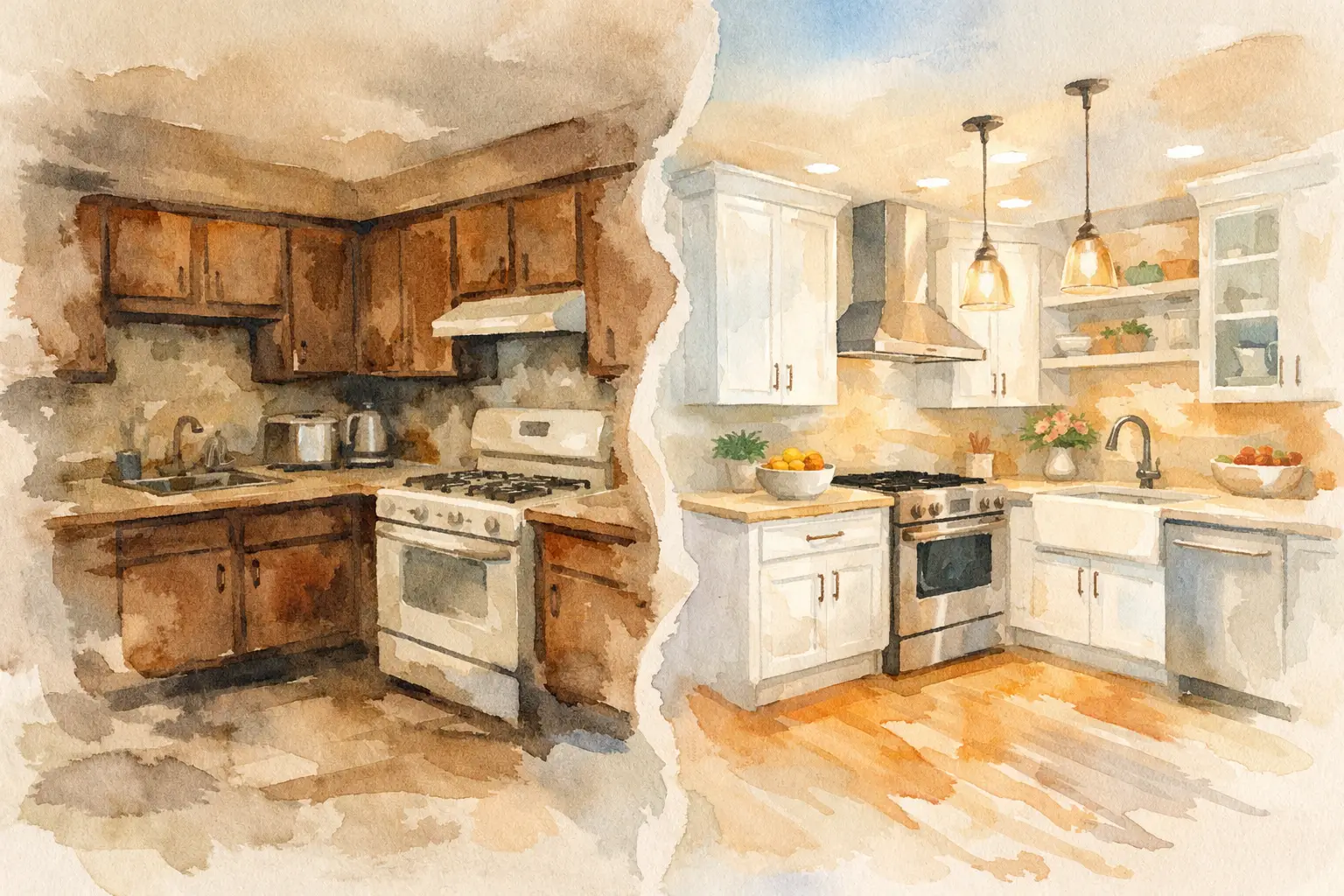
A lot of homeowners know their kitchen looks tired, but they are not sure whether they need a full renovation or a smarter refresh. That is where kitchen refacing before after examples can be so helpful. When you see what actually changes – and what does not – it becomes much easier to decide whether refacing fits your goals, your budget, and the way your family uses the space.
Refacing is not magic, and it is not the right answer for every kitchen. But in the right layout, it can make older cabinets feel current, cleaner, and far more intentional without tearing the whole room apart. The most useful examples are not just about color changes. They show how door style, finish, hardware, trim details, and surrounding updates can completely shift the feel of the kitchen.
Cabinet refacing keeps the existing cabinet boxes in place while updating the visible surfaces. That usually means new doors and drawer fronts, a matching veneer or finish on exposed cabinet areas, and often new hardware. In many projects, homeowners also pair refacing with countertops, backsplash, lighting, or flooring to make the transformation feel complete.
The key limitation is layout. If your kitchen suffers from poor traffic flow, not enough storage, awkward appliance placement, or damaged cabinet boxes, refacing may only improve appearance, not function. That is why the best before-and-after results happen when the kitchen already works reasonably well and simply needs a fresh, more updated look.
This is one of the most common before-and-after transformations. The “before” often features golden oak cabinets, raised-panel doors, visible wood grain, and older brass or oil-rubbed hardware. Nothing may be technically wrong with the cabinets, but the kitchen can feel dated the moment you walk in.
The “after” usually swaps those fronts for painted shaker-style doors in white, soft gray, greige, or a muted green. Add simple black or brushed nickel pulls, and the entire room feels brighter and more current. Homeowners often say the kitchen looks larger afterward, even though the footprint has not changed.
The trade-off is maintenance. Painted finishes can show wear differently than stained wood, especially around high-touch areas. If you have young kids, heavy traffic, or prefer something forgiving, a warm wood-tone reface might make more sense than bright white.
Some kitchens have solid cabinet construction but feel closed in because everything is the same dark finish. In these cases, refacing can lighten the perimeter cabinets while keeping the island or lower cabinets in a darker contrasting color.
The before-and-after difference is less about replacing “bad” cabinets and more about changing visual weight. A kitchen with dark cherry or espresso cabinetry can go from heavy and enclosed to balanced and open just by introducing a two-tone scheme. White uppers with navy lowers, or light taupe uppers with a stained wood island, can create depth without a full rebuild.
This works especially well in kitchens that do not get much natural light. It also shows that refacing does not have to mean making everything one flat color. Sometimes the best result is giving the room more contrast and rhythm.
Another strong example comes from kitchens with ornate or overly traditional cabinet fronts. Arched raised-panel doors, decorative routed edges, and bulky trim can make a kitchen feel stuck in a different decade.
After refacing with slimmer profiles and simpler lines, the same cabinet layout feels far more timeless. This kind of update matters because style is often carried more by the door shape than homeowners realize. Even when countertops stay in place for a while, cleaner cabinet fronts can calm the entire room down.
If your home leans traditional, you do not have to swing all the way to ultra-modern. The right after photo often lands in the middle – simple enough to feel current, classic enough to still fit the house.
Some before-and-after refacing projects are less about dramatic color and more about adding detail. A plain builder-grade kitchen might start with flat cabinet ends, short upper cabinets, minimal trim, and small knobs that do not do much for the room.
After refacing, added crown molding, updated end panels, under-cabinet lighting, and better-scaled hardware can make the kitchen feel more finished and custom. The cabinet boxes may be the same, but the visual impression is completely different.
This is an important example because it shows how refacing can be part of a broader improvement plan. If the layout works and the cabinets are structurally sound, thoughtful finish upgrades can bring a kitchen much closer to a full-remodel look than many homeowners expect.
The strongest kitchen refacing before after examples usually share one thing: the homeowners were clear about what problem they were solving. Sometimes that problem is dated style. Sometimes it is a dark room that needs to feel brighter. Sometimes it is simply wanting a cleaner, more valuable-looking kitchen without the cost and disruption of starting from scratch.
What they are not doing is forcing refacing to fix issues it cannot solve. If drawers stick, cabinet boxes are failing, storage is poorly planned, or the kitchen feels cramped because of the layout, those issues deserve honest attention. A fresh cabinet surface will not make a frustrating kitchen function well.
That is why a good contractor starts with the condition of what is already there. Refacing should be recommended because it fits the kitchen, not because it is the fastest option to sell.
Refacing makes sense when your cabinet boxes are in good shape, your layout serves your household, and your main goal is to improve appearance. It can also be a smart move if you want less disruption than a full kitchen remodel. For busy households, that matters. Less demolition often means a more manageable project timeline and less mess inside the home.
It may not be the best choice if you want to move walls, add significantly different storage features, or correct a kitchen that has never worked well. In those cases, a full remodel often gives better long-term value because it addresses both function and finish.
This is where local experience matters. In many Louisville-area homes, especially older ones, kitchens may have solid bones but outdated finishes. In those situations, refacing can be a practical middle path. In other homes, especially where storage and flow are major complaints, homeowners are often happier investing in a larger redesign.
Before-and-after photos are useful, but they can also be misleading if you only focus on color. When you review examples, look beyond the obvious finish change. Ask whether the kitchen feels brighter because of cabinet color alone or because lighting, backsplash, and counters were updated too.
Pay attention to door style, hardware scale, trim details, and how the cabinets fit the rest of the room. A good transformation usually feels cohesive. The cabinets do not look like they were changed in isolation. They look like they belong in the kitchen.
Also ask what stayed the same. If the layout remained intact and the room still looks dramatically better, that is a strong sign that refacing may be enough for your home. If every stunning after photo also involved major structural changes, you may actually be looking at remodel results, not true refacing outcomes.
The homeowners happiest with refacing are usually the ones who treat it as a design decision, not just a shortcut. They choose finishes that fit their home, pair cabinet updates with a few supporting improvements, and work with a remodeler who will be honest about the limits of the existing space.
At 3C Remodeling and Construction, that conversation starts with how you use your kitchen every day. If refacing is the right fit, it should leave you with a kitchen that looks better, feels more current, and supports daily life without unnecessary disruption. If it is not the right fit, you should hear that clearly before the project begins.
Before-and-after photos can spark ideas, but your own kitchen deserves more than a copy of someone else’s result. The best transformation is the one that matches your home, your routine, and what you want this space to do for you next.
Business Name: 3C Remodeling and Construction
Address: 1902 Campus Pl Suite 12, Louisville, KY 40299
Phone: 502-827-1361
Business Hours:
Mon - Fri: 08:00 AM to 05:00 PM
Sat-Sun: Closed
Referral program available